
Precision Planetary Roller Screw Machining Solutions
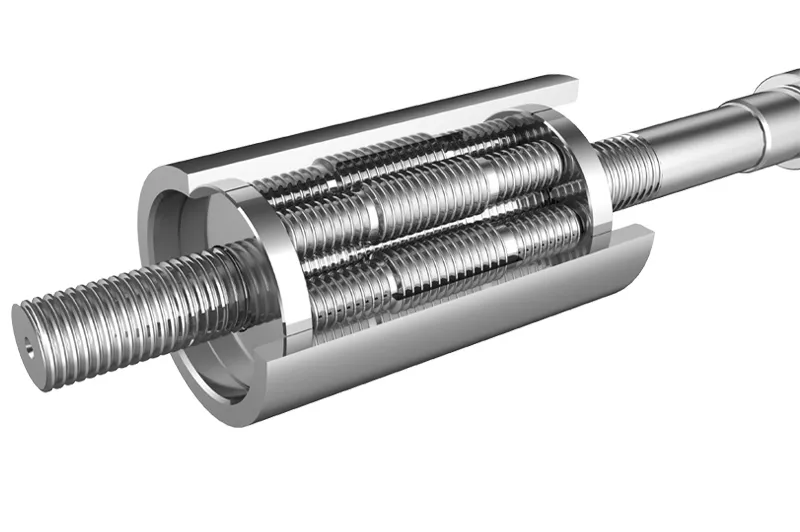
Planetary roller screws are high-precision, heavy-load mechanical transmission devices composed of a screw, a nut, and planetary rollers. Unlike ball screws planetary screws utilize "line contact" between the rollers and the screw. This fundamental difference results in significantly higher load-bearing capacity, superior rigidity, stronger shock resistance, and a longer service life within a compact footprint. They are the preferred choice for aerospace, heavy industry, energy sectors, and high-force industrial robotics.
Process Flow
Bar Stock Preparation
Soft Roughing
Induction Heat Treatment
Hard Whirling / Precision Grinding
Polishing
Key Process Solutions
Induction Heat Treatment
The Challenge
- Deformation Control: Planetary screws often feature complex multi-start threads and slender structures. This makes them extremely susceptible to bending, leading to lead errors, pitch deviations, and straightness issues during heating.
- Stability Issues: Maintaining dimensional stability and controlling hardness uniformity across the entire length is difficult with traditional methods.
Our Solution
Recommended Equipment: Vertical Induction Hardening Machine
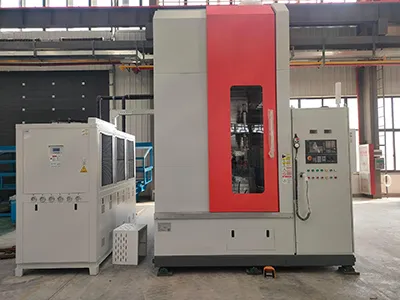
- Vertical Architecture: Features a vertical layout specifically designed to minimize gravitational distortion during the heating of long screw shafts.
- Induction Physics: The machine inputs medium or high-frequency current into the coil to generate an alternating magnetic field. This induces eddy currents on the screw surface, causing it to rapidly heat to the quenching temperature (850–900°C).
- Precise Quenching: Immediate spray cooling transforms the surface into a high-hardness Martensite structure while the core retains its toughness. This ensures uniform heating even on the complex multi-start profiles required for planetary screws.
Hard Whirling
The Challenge
- Accumulated Errors: Traditional processing relies on multiple disjointed steps. This results in cumulative pitch errors that cannot meet the "micron-level" transmission requirements of high-end equipment.
- Production Bottlenecks: The conventional workflow (turning + multi-pass grinding) is inefficient. A single screw can take 8–12 hours to process, making mass production and timely delivery nearly impossible.
Our Solution
Recommended Equipment: Planetary Screw Whirling Machine
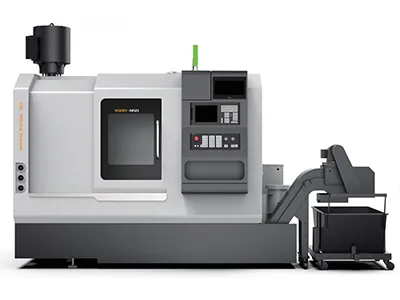
- Process: Features a high-precision CNC system paired with custom PCBN tooling to perform hard whirling directly on heat-treated workpieces.
- Performance: Supports dry cutting (no coolant needed). The process is stable and energy-efficient, capable of achieving a raceway surface roughness of Ra 0.4 μm in typical conditions.
Recommended Cutting Tools: PCBN Tools (Tool Bits for Whirling)
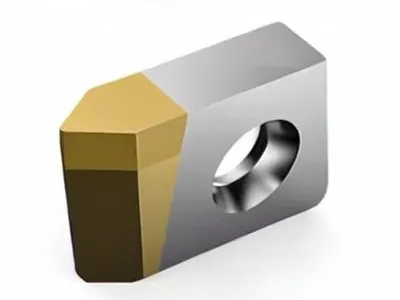
- We provide specialized PCBN grades and edge structures designed for screws made of GCr15, 4150, and other materials heat-treated to HRC 58–62.
- Versatility: Ensures high precision and dimensional consistency, with specific grades available for difficult-to-cut materials like stainless steel.
Thread Grinding
The Challenge
- Workpiece Deformation: Long screws are prone to bending under the combined effects of gravity and cutting forces, which compromises straightness.
- Thermal Growth: Heat generated during grinding causes the workpiece to expand. Precise control over cutting parameters and cooling is essential to prevent dimensional errors.
- Surface Quality: Meeting the strict surface roughness requirements for planetary interaction requires rigorous selection of grinding wheels and lubrication.
Our Solution
Recommended Equipment: CNC High-Precision Thread Grinding Machine
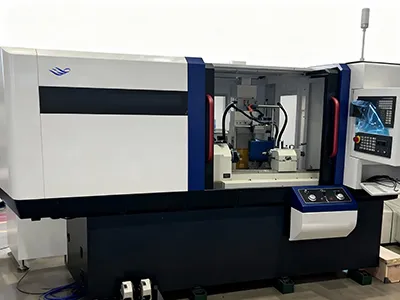
- Precision Control: Utilizes single-line or form grinding wheels to perform precision grinding along the screw’s helix.
- Outcome: Delivers the perfect balance of high precision and high efficiency, ensuring the screw meets the rigorous geometric tolerances required for planetary roller integration.